Overview
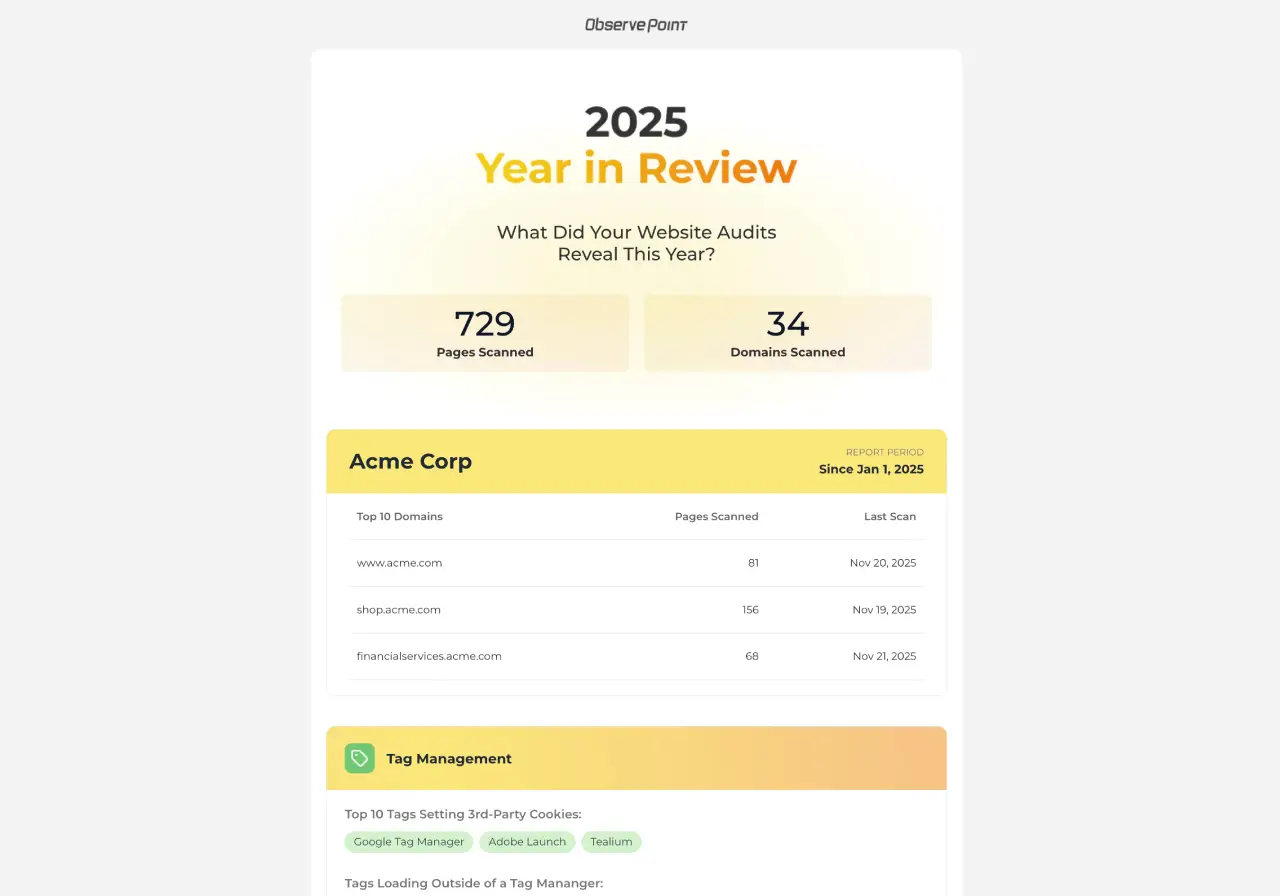
This is a customer-facing “Year in Review” email sent annually to ObservePoint accounts. It surfaces personalized audit data across five key categories — Tag Management, Consent Management Platforms, Cookie Analysis, Web Vitals Performance, and WCAG 2.1AA Accessibility — along with tailored recommendations and an upsell section encouraging customers to expand platform usage across their organization. The email closes with a referral incentive and a direct line to the customer’s CSM.
Why it's notable
Most engineers treat HTML email as a solved problem. It isn’t. This template required deliberately unlearning modern web development: no flexbox, no grid, no CSS variables, no position, no calc(). Every layout decision had to survive Outlook’s Word-based rendering engine, Gmail’s aggressive style stripping, and Apple Mail’s auto-scaling, simultaneously.
Beyond compatibility, the engineering challenge was building a data-driven layout system in pure table HTML. Variable-length content (different numbers of domains, tags, cookie vendors, and accessibility scores per customer) had to flow cleanly without breaking the grid. Pill containers, two-column stat boxes, and bordered data tables all needed to stack gracefully on mobile using nothing but inline styles and media query overrides injected into the <head>.
The result is a template that reads like a polished product but is built on constraints most front-end developers never have to work within.
Unique challenges
Building a fully responsive HTML email that renders consistently across major clients (Outlook, Gmail, Apple Mail) using table-based layouts with no flexbox and no grid. Designing data-heavy sections like domain comparison tables, metric pills, and two-column feature lists that remain readable and well-structured at mobile widths. The template also had to accommodate variable-length customer data (different numbers of domains, tags, and vendors) without breaking layout, requiring careful use of spacers and conditional structure.
 Web Apps